Reduce Visual Clutter Fast with These Home Styling Tips (Coastal-Approved!)

Part 1 of the Clear the Chaos Mini Series: Tackling Visual Clutter
Why Your Home Still Feels Chaotic: It Might Be Visual Clutter
You’ve decluttered. You’ve tidied. You’ve even bought the cute baskets.
So why does your home still feel kind of cluttery?
Here’s the truth: clutter isn’t always about the stuff.
It’s often about what your eye sees—even when the counters are clean.
When your colors, containers, and decor don’t flow together, it creates visual clutter—that low-key “off” feeling that makes a space feel busy, even when it’s technically clean and organized.

How to Clear the Visual Clutter
The good news? You don’t need a total overhaul.
A few intentional tweaks to your color palette and the way you style what stays can go a long way. These small shifts can make your home feel noticeably calmer and more pulled together.
Let’s break it down.
1. Tidy ≠ Visually Calm
Visual Clutter Looks Clean—but Feels Chaotic
Your surfaces might be clear and your bins labeled, but that doesn’t always add up to a calm-feeling space.
Visual clutter is anything that makes your eye dart around:
- Busy gallery walls with too many small frames
- Open shelving packed edge-to-edge
- Mismatched rugs in every room
- Stuff stashed on top of your fridge, cabinets, or under open benches
Ask yourself:
- Is my home full of small things in large quantities?
- Are there multiple textures or patterns competing for attention?
- Are my shelves or walls filled simply because they could be?
Sometimes, it’s not about needing more storage. It’s about needing fewer visual “noises” in the room.
✅Try This:
- Swap those 27 tiny frames (you know who you are!😜) for 5 larger, more intentional pieces
- Clear one open shelf completely (literally, take everything off!) and re-style it with a single focal point
- Remove throw rugs that feel more in-the-way than helpful (even if they match)
2. A Cohesive Color Palette Makes All the Difference
How Color Choice Impacts Visual Clutter
Color might be the #1 reason your home feels disconnected.
And I’m not talking about bold vs. beige—this is about how all the tones work together. Even the prettiest decor can feel cluttered if it doesn’t match your home’s overall vibe.
✅Try This: Stand at your front door and look in.

- Do you see a calming flow of color from room to room?
- Or is it a patchwork of bright accents, bold rugs, and clashing tones that don’t talk to each other?
- Is your eye drawn to one focal point—or bouncing between too many things at once?
If it’s hard for your eye to settle—or to immediately feel the vibe of your home—your color palette may be working against you.
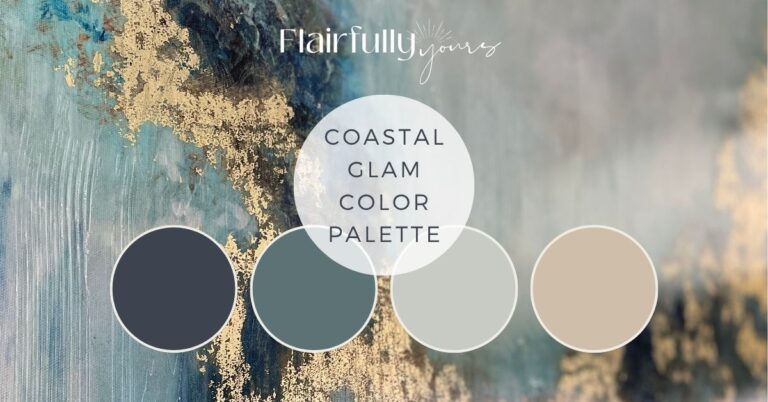
A defined, coastal-inspired color palette gives your home a polished, peaceful feel—without removing your personality. It’s not about everything being matchy-matchy. It’s about purposeful repetition.
Bring That Palette to Life, Room by Room
👉 How To Do This:
Pick one soft accent color (like a dusty blue, muted teal, or sandy blush) and repeat it thoughtfully in small ways—pillows, artwork, towels, vases.
If something doesn’t fit your color story, either rotate it out or relocate it to a spot where it supports the overall flow. Grouping it with similar tones can sometimes help—but only if the whole area still feels calm and cohesive, not forced.
How to Organize Your Home with Coastal Colors That Flow
✅ Try This: Use One Accent Color Across Your Home

Let’s say your chosen accent is a soft blue green. You might:
- Repeat it in throw pillows, a framed art print, or a vase in the living room
- Use it in a bath towel or countertop jar in the bathroom
- Add it to a bowl, small tray, or runner in the kitchen
🪄 Pro tip: If you already have a big dose of that accent color—like on a vanity, piece of furniture, or area rug—let that be the hero. Keep other uses of that color in the room minimal so the space feels calm, not overdone.
Even too much of your favorite color can turn into visual clutter.
Want help planning your palette? Start here:
3. Don’t Just Declutter—Curate
How to Organize Your Home with Decor That Breathes
Even if you love every individual item, the way it’s styled matters.
That open shelving unit in your kitchen? If every inch is filled—even with cute things—it still might feel chaotic. Same goes for what’s topping your cabinets or lining your laundry floor.
✅ Try This: Instead of decluttering by category, try decluttering by sightline.
Ask yourself: What does my eye see first when I walk into this room?
Love this idea? Keep it handy.
Start with that view. Clear or simplify the visible surfaces and wall space in that immediate line of sight—like countertops, open shelves, or gallery walls.
You don’t have to strip it bare—just aim for one focal point and a little breathing room around it. Once that spot feels calm, move on to the next most noticeable area.
One More Thing to Keep in Mind:
Got a favorite piece you really want to show off? A framed photo, a sculptural vase, a beautiful bowl?
Be careful not to crowd it with too many extras.
When you overdecorate around something special, you’re not highlighting it—you’re hiding it.
The more “stuff” you pile around it, the more it blends in.
Instead, let your favorite piece breathe. Give it space to shine, and it’ll draw the eye exactly how you hoped it would.

How to Curate Your Decor (Not Just Organize It):
- Work in vignettes. Group 3–5 items, then leave breathing room between groupings.
- Use trays or risers. Contain smaller items to give them a purpose.
- Go for a layered look… then stop. One intentional setup per surface is usually enough.
🚫 A Quick Word on Tiny Accents

Tiny Accents, Big Clutter: When Small Decor Takes Over
This is where most of us go overboard (guilty as charged):
- Little vases.
- Mini candles.
- Tiny bowls.
- Too-small wall art.
- Stacks of mini books.
- Knickknacks from every vacation.
- Small baskets, bins or trays that don’t actually corral anything.
- Tiny frames in every room.
- Tiny pumpkins in fall. Tiny trees in winter. Tiny everything.
- 2’x3′ throw rugs EVERYWHERE
They’re fun to buy and look adorable in the store or on Pinterest.
But when you’ve got 19 little vases or 37 tiny frames scattered around?
That’s not decor. That’s visual clutter.
What to do instead:
- Pick your favorites. One or two per room, max. Rotate seasonally if you love them all.
- Think scale. One larger piece often feels calmer than a group of tiny ones.
- Contain them. A tray, a riser, a shelf with negative space—it all helps your eye rest.
🪄 The goal is for your eye to rest, not ricochet.

Bonus Styling Tip: Try this approach on your coffee table vignette for a clutter-free focal point.
🪟 4. Look Up, Down, and All Around (Including Between)
How to Spot Hidden Visual Clutter in Your Home
Some clutter isn’t on your surfaces—it’s hiding:
- Above the cabinets or fridge
- Below in your pantry or laundry floor
- Behind the curtains that are too heavy or patterned for the room
- Between furniture that’s too tightly packed
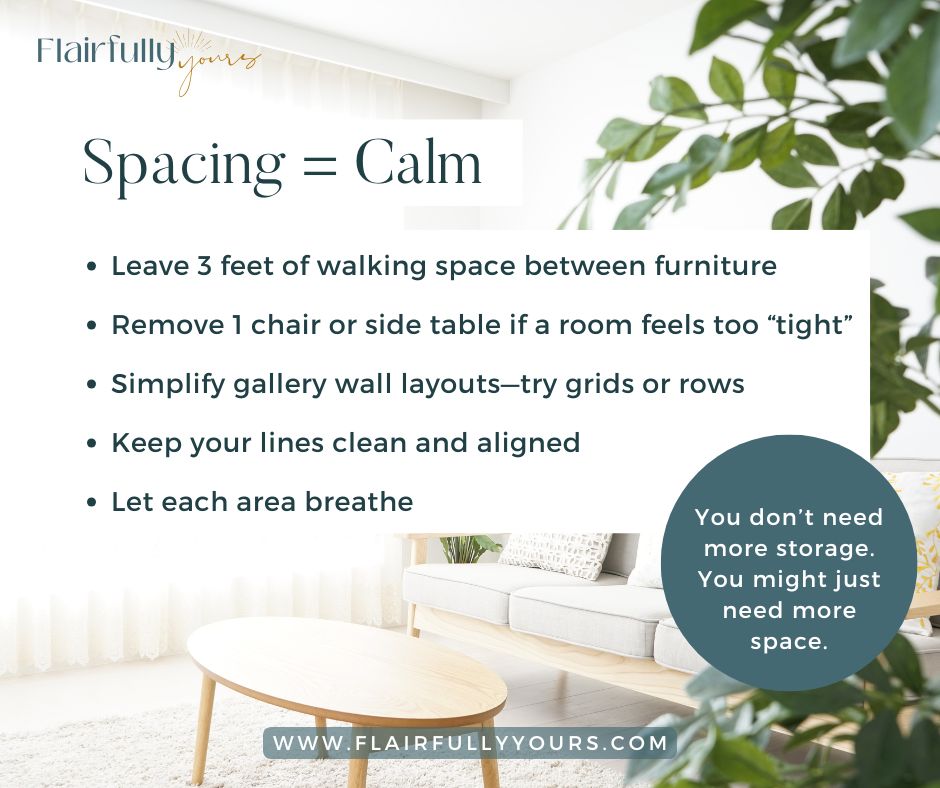
The spacing tip no one talks about:
Furniture placement matters.
If your room feels like it’s bursting at the seams—even if it’s organized—it probably needs better spacing. Try removing one extra piece and see how much calmer it feels.
More ways to reduce visual clutter:
- Keep your lines clean. Align stacks, straighten frames, and tidy corners. Neatness makes a bigger impact than you think.
- Simplify gallery walls. A grid or clean row is much calmer than a scattered mix—especially near shelves or windows where your eye already has a lot to process.
- Be picky with throw rugs. One bold rug can ground a space. But layering rugs in every room—or using several styles that don’t coordinate—adds more visual noise than comfort.


Neat frames still cause visual clutter if they’re packed in without flow. Try spacing them out or aligning your layout—your eyes will thank you.
Feeling inspired to do a little decor reset? Grab my Spring Decor Cleanout Checklist—it’s full of 10-minute wins to calm your home, whether it’s spring or just a Tuesday. (Includes a downloadable checklist ✅)
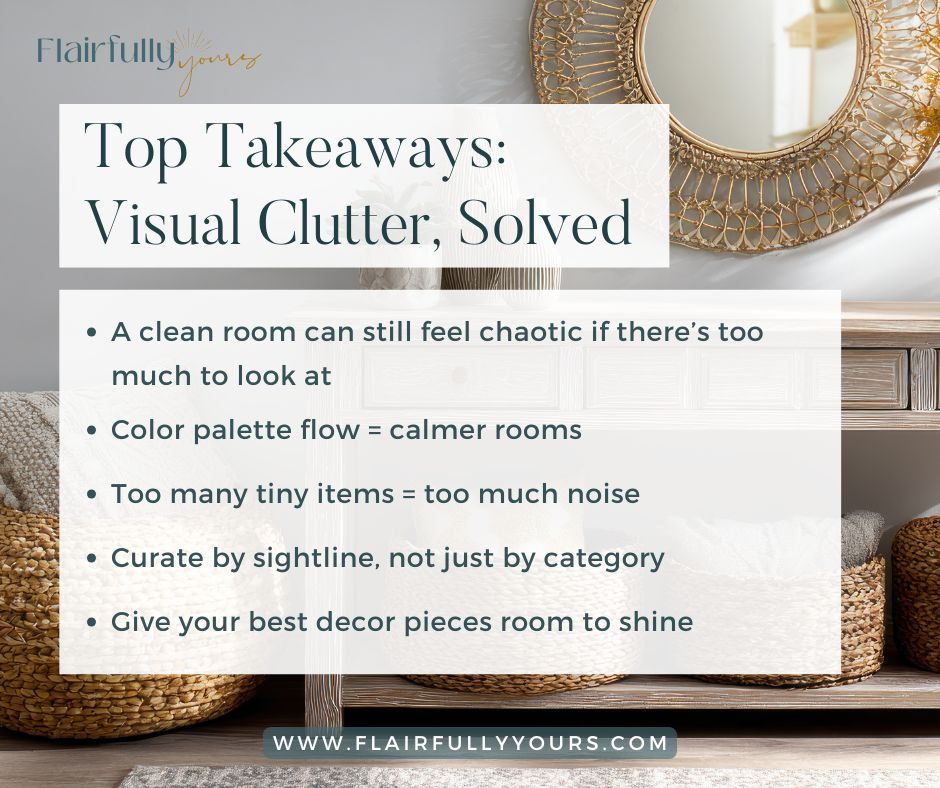
📌 Save these visual clutter fixes before you reorganize anything!
Want even more ways to calm the chaos?
Grab the Home Decor Checklist I share with clients—it’s a quick-hit list of what to adjust when a room still feels “off” even after tidying.
✨ Ready for the Next Step?
Once you’ve calmed the chaos with these visual tweaks, it’s time to tackle what’s actually taking up space.
👉 Here’s your follow-up plan: 6 simple steps for when you’re dealing with too much stuff.
From floor piles and overstuffed surfaces to mudroom mayhem, this guide shows you how to sort it all—and bring back the calm, one spot at a time.